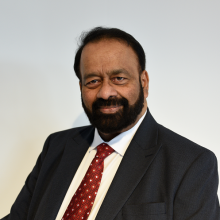
Biography:
Dr. Buddy Liyanage has been serving as a Senior Visiting Lecturer and Advisor to the University of Colombo School of Computing (UCSC) for over twenty years. He brings extensive expertise in cybernetics, networking, cybersecurity, and security architecture. He received his BSc in Physics (Honours) from the University of Colombo, followed by an MSc in Modern Electronics from the University of Nottingham. He subsequently completed his PhD in Cybernetics at the University of Reading in the United Kingdom. He has also served as the Head of Security Architecture for over seventeen years.
The need for responsible, ethical, and trustworthy AI systems and their use in Sri Lanka
Sri Lanka stands at a significant point in its national digital transformation, driven by policy ambitions to expand its digital economy to US$15 billion and establish the island as a regional technology hub by 2030. Rapid artificial intelligence (AI) use presents dual realities: promising innovations (such as AI-assisted diabetic retinopathy screening in low-resource regional clinics) alongside significant societal vulnerabilities (such as political deep fakes, investment fraud, and automated misinformation). This keynote address argues that responsibility, ethics, and trustworthiness are not optional additions to digital development but essential engineering requirements without which technology alone will not deliver sustainable value.
The address establishes formal conceptual precision by delineating ethical AI (normative human values), responsible AI (institutional accountability and governance), and trustworthy AI (verifiable technical reliability), while addressing the global principles-to-practice gap in a Sri Lankan context. Using grounded Sri Lankan case studies spanning healthcare diagnostics, social welfare eligibility, agricultural crop advice, child protection in education, sustainable higher education, democratic integrity, and local-language model performance, the speech demonstrates how algorithmic bias, opacity, and linguistic disparities in Sinhala and Tamil can impact society. It highlights the foundational legislative anchors in Sri Lanka’s Personal Data Protection Act (PDPA No. 9 of 2022), which grant citizens explicit statutory rights regarding automated decision-making.
To translate policy vision into operational readiness, the address concludes by outlining a practical national action roadmap with multiple points. Key recommendations include integrating mandatory AI risk evaluations into Data Protection Impact Assessments (DPIAs), enforcing responsible public procurement standards for AI, establishing university-hosted Sinhala and Tamil evaluation test beds, guaranteeing citizens’ statutory rights to explanation and administrative appeal, and fostering civic AI literacy. Ultimately, the speech challenges researchers, policymakers, and industry leaders to evaluate national progress not merely by the volume of deployed algorithms and AI systems, but by the depth of public trust in such systems, demonstrating AI trustworthiness in Sri Lanka.
Keywords: Responsible AI, Ethical AI, Trustworthy AI, AI Governance, Sri Lanka